Smart tools redefine the modern workplace
Offices are changing. Return-to-office mandates and hybrid-work models have led companies to rethink their spaces. Furniture makers are responding with designs that emphasize flexibility, sustainability, and comfort, often combining playful aesthetics with practical improvements.
Modular sofas that reconfigure like building blocks
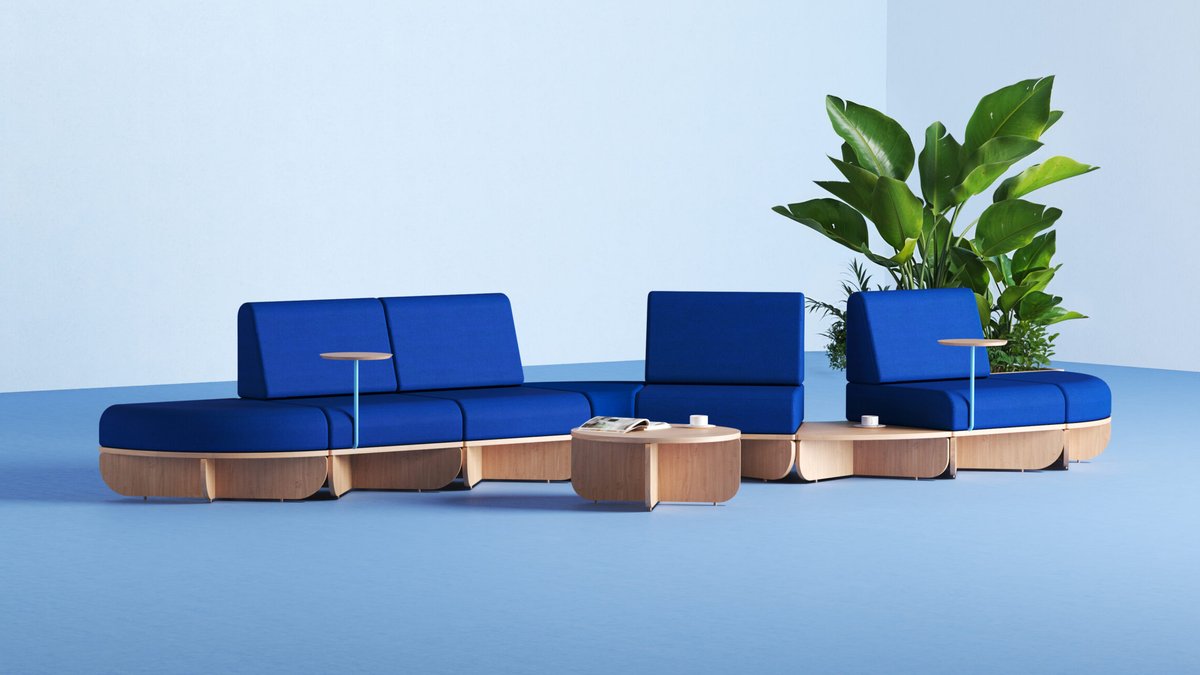
Dutch firm Mecanoo and manufacturer Bert Plantagie created Macaron, a modular sofa system inspired by the French pastry. Its rounded form stacks a base, seat, and backrest in layers, available in shapes like arcs, half-pills, or wedges. The pieces can be rearranged for different settings, from collaborative lounges to private nooks. Colors range from neutral to bold, allowing companies to match the system to their brand or office palette.
The design prioritizes movement. The modules are built to be relocated often, which matches how offices now shift layouts to accommodate different teams and tasks. This adaptability may reduce the need for new furniture when spaces are redesigned.
Fabrics built to last decades—and stay clean
Maharam worked with fashion designer Paul Smith to update an earlier upholstery collection, Overlapping Stripe, with a larger, airier pattern in seven colorways. The fabric combines cotton-nylon and postconsumer-recycled polyester and includes a water-repellent finish free of PFAS chemicals. It withstands 100,000 double rubs in industry testing, a standard for durability.
Pallas Textiles introduced NetZERO Bio, a material made from regeneratively grown dent corn and recycled polyester. The fabric endures 500,000 double rubs and can be cleaned with bleach. Both products reflect a shift in office design toward materials that reduce waste and chemical exposure.
Most offices still use furniture replaced every few years. These fabrics suggest a move toward pieces built to endure, even as companies downsize or reconfigure their spaces.
Work pods that move quietly and maintain clean air
Silen’s latest work pods are slimmer and lighter than earlier versions, with more recycled materials and integrated casters for easy relocation. The pods include a quiet ventilation system, preset lighting scenes, and antibacterial-lined ducts to improve air quality. Acoustic isolation remains a key feature, making them useful for focus work or private calls in open offices.
Related: 8 Fruits and Vegetables That Fail in Pots
The ability to move the pods without disrupting workflows may appeal to companies that frequently reorganize teams. The hygiene features also address concerns about shared spaces that emerged after the pandemic.
Chairs designed to outlast trends
Keilhauer’s new Yabu Pushelberg–designed lounge collection, Etta, includes chairs that can be specified with wood or metal legs, some with swivel bases.
Lighting and tables that simplify workspaces
Fríant Plus’s Classic Wood Table with Light Bar combines a trestle-style table with an integrated LED rod, removing the need for separate task lamps. The 86½-inch-wide table is made from red oak, reinforced with tenon-and-mortise joinery and a natural wax-oil finish. The design keeps workspaces uncluttered while providing direct lighting for collaboration.
ADL’s Aria screen, designed by Yabu Pushelberg, uses a slender aluminum frame and glass with a linen interlayer to create intimate spaces within larger offices. Available in two sizes and a double-panel model, the screens come in finishes like light bronze and chlorophyll. They offer privacy without permanent walls, supporting flexible, open layouts.
Many of these products focus on longevity and adaptability, traits that could extend beyond corporate spaces. Schools, co-working hubs, and even homes blending tradition might adopt similar approaches as hybrid work blurs the lines between living and working environments. The emphasis on recycled materials and low-chemical finishes also reflects broader concerns about health and sustainability in shared spaces.
The real test will be how these designs perform in high-traffic offices. Durability claims like 500,000 double rubs are measured in lab conditions. Daily use, where coffee spills and constant reconfigurations are common, will determine whether they become staples or novelties.
Sustainability as a priority, not just a checkbox
Keilhauer’s Etta lounge collection, designed by Yabu Pushelberg, includes 26 pieces certified carbon neutral and Greenhealth Approved. The line offers modular sofas, nesting tables, and chairs with wood or metal legs, some with swivel bases. Tables can be topped with wood, laminate, or quartz. The carbon-neutral label means the company offsets emissions from production, going beyond recycled materials.
Related: Stihl pruner packs surprising cutting power
Room & Board for Business expanded its Urban Wood Project, which turns urban wood diverted from landfills into furniture-grade timber. American elm is now an option for the company’s Hensley collection, a line of storage cabinets. The program shows how waste from urban tree removal can become a resource for another industry.
Pallas Textiles’ latest development is NetZERO Bio, made using GRS transaction-certified polyester and bio-attributed polyurethane built on Susterra, an ingredient produced from regeneratively cultivated dent corn. Currently, it’s available for four of the company’s textiles, all bleach-cleanable and able to withstand up to 500,000 double rubs.
Designtex’s dimensional textile features a raised moss-evoking haptic pattern in soft velvet, offered in four colors—Moss, Cloud, Poodle (black), and Teal—and composed of 100 percent postconsumer recycled polyester. It withstands up to 100,000 Martindale cycles and can include optional PFAS-free stain-resistant finishes.
Autex Acoustics and Emma Hayes Textiles collaborated on Vicinity, a collection of four acoustic panel designs inspired by New Zealand’s natural settings. Printed on Autex’s Cube panels, which contain a minimum of 80 percent recycled PET, the designs are fully customizable in color, dimensions, and mounting options.
Industrial designer Hlynur Atlason created Mason by Atlason, a collection of 12-inch-square acoustic tiles for Wolf-Gordon. Part of the GATHER series, the tiles mimic masonry patterns in eight grid-based designs, rendered in 100 percent recycled materials.
These efforts indicate sustainability is no longer a niche concern in office design. For companies under pressure to meet environmental, social, and governance goals, furniture with clear eco-credentials may become a default choice rather than an upgrade.
The challenge remains accessibility. High-end designs often carry price tags that limit them to corporate headquarters or tech campuses. If the goal is to reshape offices broadly, the next step may involve scaling these innovations without sacrificing quality or sustainability.


