Maui Home Blends Tradition and Sustainability
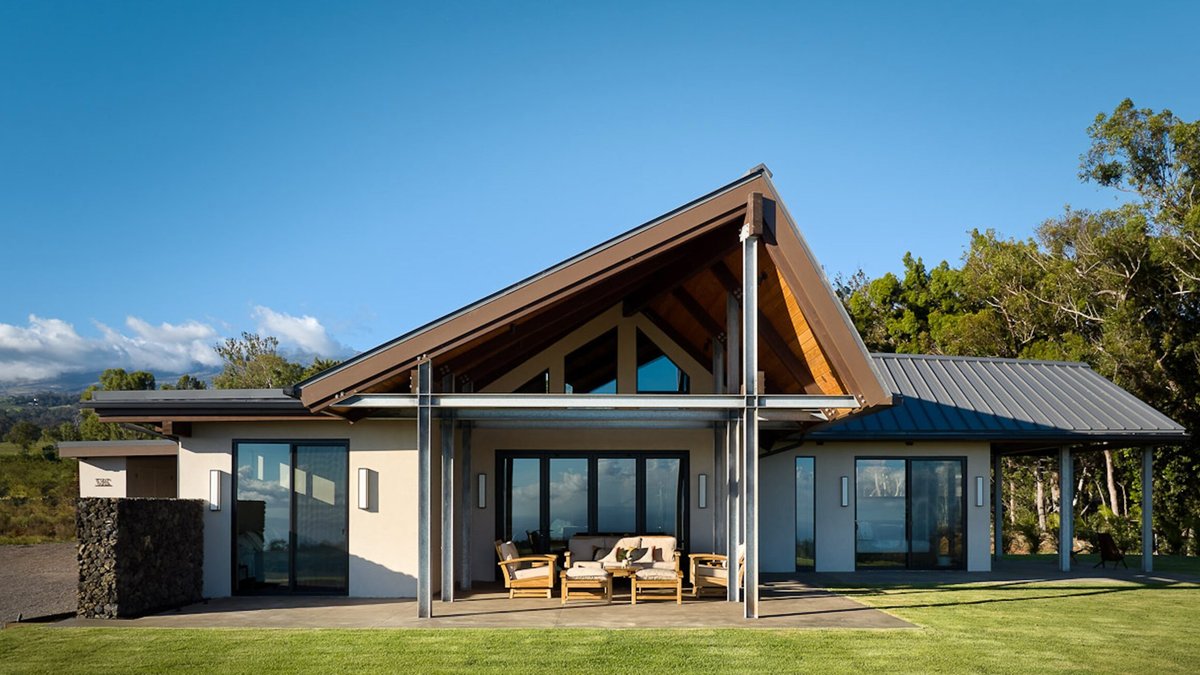
Kupono Hale, a single-family residence on the northern slopes of the Haleakalā volcano, combines passive design, solar power, and local, upcycled materials in a new vision of Hawai‘i Contemporary. The average sea level at Kahului Harbor has risen a full five inches since 1950, and the prevailing wind direction has shifted from northeast to due east, according to David Sellers, who was part of a group helping develop a climate action plan for the island of Maui.
Sellers, who grew up in Texas and studied architecture and building science at Delft University of Technology in the Netherlands, says, “This is climate change that I can see in my lifetime.” The need for an architecture capable of responding to the many changes wrought by a warming climate was the driving force behind the design of Kupono Hale.
Kupono Hale is completely off grid yet produces enough solar energy to power the home and charge the owner’s electric vehicle. The house’s design combines passive design principles with renewable energy systems and local, upcycled materials, making it a demonstration of how to build a sustainable home.
Hidden behind layers of stucco, Kupono Hale’s walls are constructed with custom insulated composite concrete forms made partially from expanded polystyrene foam salvaged from local surfboard shapers. The technology, known as Surf Block, mixes cement and recycled EPS and shapes it into five-foot-long, CMU-style blocks that can be cut, stacked, and arranged in endless combinations.
The blocks are lightweight and fire resistant and serve as both the forms for a wall’s poured-in-place concrete and its insulation, achieving double the R-value of a standard wall assembly while diverting waste from the landfill. A more visible environmental feature is the house’s parabolic roof, which emerged from a desire to orient the house toward the site’s most dramatic view while adhering to passive design principles.
Related: Amazon cuts fan prices, up to 41% off
Forming the roof are glulam beams and ceilings made from locally sourced Cook pine, a tree introduced to Hawai‘i as part of an ill-fated effort to establish timber plantations. Sellers explains, “We have all these 80-, 90-, 100-year-old trees that are actually safety hazards [and] a nuisance,” and has since milled Cook pine from his own property.
A nearly equal square footage of covered lanai extends the living space outdoors, reflecting Hawai‘i’s vernacular and the home’s reliance on natural ventilation and cross ventilation. High ceilings, ample windows, and locally milled Cook pine blur the boundary between inside and out.
Helping keep its energy demand low is the home’s size, with the two-bedroom house’s interior measuring just 998 square feet. Yet with the high ceilings, ample windows, and three lanais, the residence feels much bigger. Sellers says, “Outdoor lanai are a big part of our vernacular. When you see a building, it should tell you a story. It should tell you about time, it should tell you about place, and it should tell you about climate.”
Kupono Hale combines passive design, solar power, and local, upcycled materials in a new vision of Hawai‘i Contemporary.


