Springsteen’s music legacy gets a home
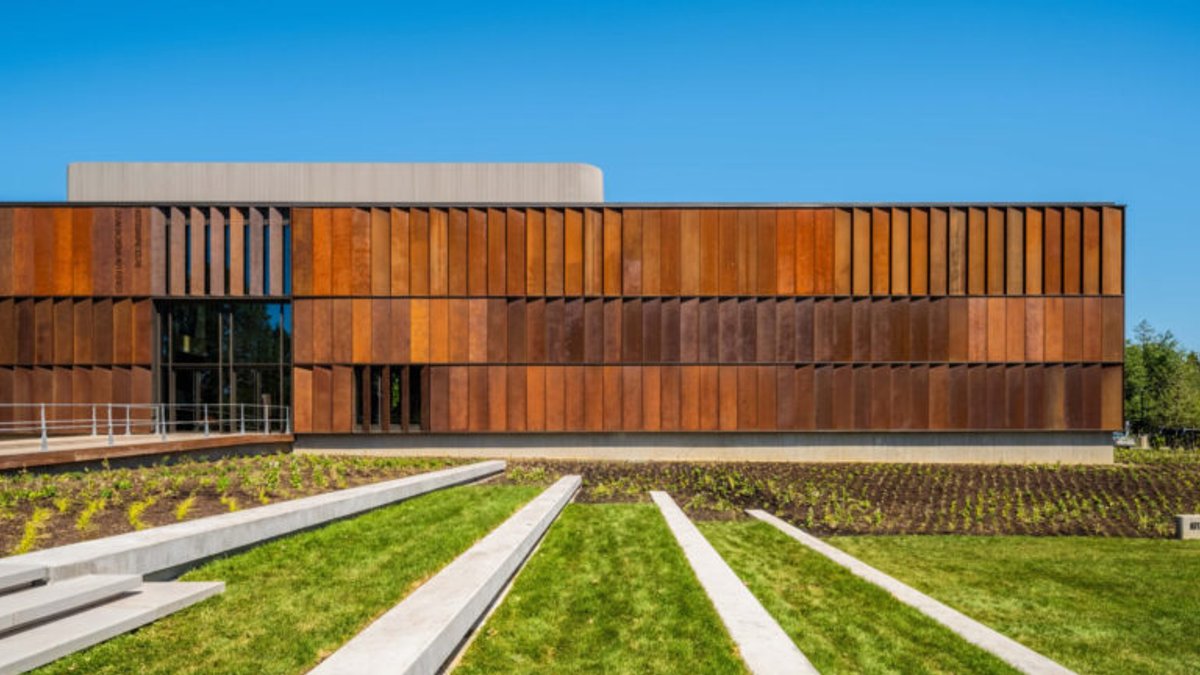
The Bruce Springsteen Center for American Music opened last June on the campus of Monmouth University in Long Branch, New Jersey, about 15 miles from Springsteen’s hometown of Freehold. The 30,000-square-foot facility includes a museum, archives, and a 240-seat performance space dedicated to American music and the artist’s career.
Design rooted in storytelling and place
CookFox Architects, a firm recognized for sustainable and socially conscious projects, designed the center. Rick Cook, the project’s design architect, recalls reading Born to Run and developing a real appreciation for Springsteen “as a great storyteller,” and his ability to bring people together. Cook also recalls seeing a performance of Springsteen on Broadway, the artist’s 2017 concert residency at New York’s St. James Theatre, and noting the detailing of the stage’s weathered wood flooring and brick wall backdrop, suggestive of an impromptu performance in an abandoned mill. “I thought about how Bruce crafted every part of that experience, every part of the spatial relationship between the audience and him,” Cook says. “As architects, we’re trying to make these physical things that tell a story … this idea of the music existing in time and the architecture existing in space was really interesting to me.”
The design reflects Springsteen’s ties to New Jersey. Rhythmical weathered steel panels on the exterior reference the state’s industrial history, while exposed mass timber inside aligns with the artist’s affinity for rustic décor. A west-facing boardwalk at the entrance recalls the Jersey Shore, and a London Plane tree on the property mirrors the copper beech that once stood outside Springsteen’s childhood home. “The building really feels like me,” he said during the opening ceremony.
Sustainability and equity in construction
Environmental and social responsibility guided the project. Construction manager Torcon used 100% union labor, a decision backed by Springsteen and the center’s board, which includes his longtime manager, Jon Landau. The team also pursued LEED v.4’s Social Equity Pilot credit, which encourages supply chain transparency. According to Charlene Chai, senior associate with CookFox, the three materials used to meet the credit were a bio-based wallpaper derived from sugarcane, FSC-certified end-grain flooring in the theater, and GreenTag-certified sealer for the decking.
The ground floor features rotating exhibits on American music traditions. The second floor houses Springsteen’s archives and galleries dedicated to him and the E-Street Band. A Dedicated Outdoor Air System (DOAS) optimizes ventilation and humidity control—critical for performances and preserving artifacts—while minimizing energy use.
Related: Five Steps to Brace for Extreme Weather Aftermath
Springsteen has frequently discussed the temporary nature of art, a concept that influenced the center’s design. In his 2016 autobiography Born to Run, he wrote, “Artists, musicians, con men, poets, mystics and such are paid to turn that math on its head, to rub two sticks together and bring forth fire.” The building, though permanent, aims to evoke that same energy—honoring history while allowing space for the future.
Preserving history in a way that feels dynamic was a key challenge. Most music museums emphasize artifacts like guitars, handwritten lyrics, or stage costumes. The Springsteen Center, however, focuses on the atmosphere between the notes. The design doesn’t just display relics; it recreates the experience of a live show, where the audience and performer share a moment.
The center’s proximity to the shore, where Springsteen spent much of his life, adds depth. New Jersey isn’t just a setting here—it’s integral to the narrative. The steel panels, boardwalk, and mass timber all connect the building to the environment that inspired his work for decades. It demonstrates how place and art influence each other.
Visitors can explore how modern tools shape creative spaces today.


