Hand-Painted Thanksgiving Sign Crafted With Drill, Paint, Stain
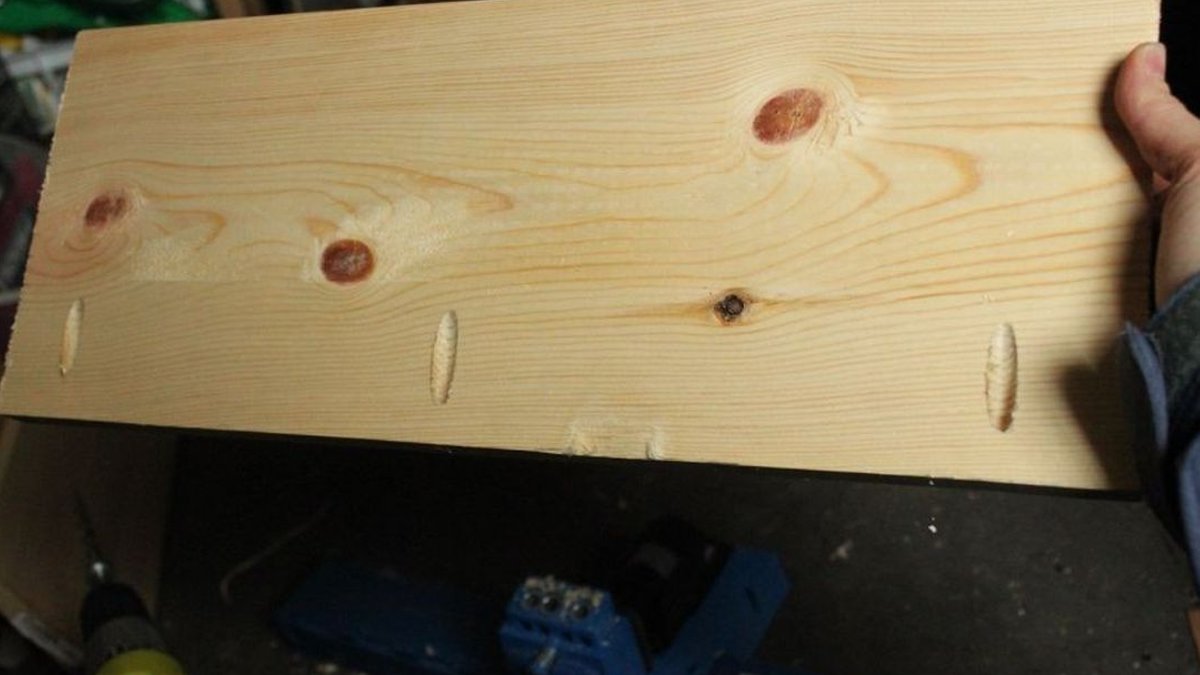
A Thanksgiving sign made from two pine boards began with a drill, not a paintbrush. Homedit contributor Brittney Smart used a Kreg jig to create pocket holes along the back edge of one 1×8 board, specifically drilling three or four holes that would later secure the boards together with screws. These holes, though hidden in the finished piece, are essential for joining the boards in a way that a single piece of wood wouldn’t require.
Following the drilling, both 18-inch boards were placed face up on a drop cloth and received a coat of white paint, with a second layer applied where the wood remained visible. Once dry, the painted surfaces were sanded, focusing on corners, edges, and raised knots to reveal the underlying wood. This process creates an aged, distressed look by exposing patches of bare wood while leaving some of the white finish intact.
A dark walnut wood stain was then applied to the sanded areas using a cloth, achieving a weathered appearance as the stain caught on the exposed wood and settled into the sanded areas. Excess stain was wiped off with a damp cloth before it dried, leaving brown marks across the white paint and darker sections around the knots. This technique enhances the farmhouse-style aesthetic while allowing the original wood grain to show through.
Read Also: Craftswoman Transforms Walnut Slab into Modern Console Table
The boards were joined using 1¼-inch pocket-hole screws, forming a rectangular panel with a horizontal seam at its center. Alternatively, metal joining brackets could have been used instead of a pocket-hole jig. The joined boards created a sturdy base ready for lettering once fully dried.
For the lettering, Smart printed the word “gobble” in a large font and utilized graphite transfer paper to trace the letter outlines onto the board. She then hand-painted the letters with acrylic paint in black, burgundy, and orange, applying a second coat to ensure full coverage. The upper board featured black for the first letter and burgundy for the remaining letters, while the lower board used orange with a black final letter. This method eliminates the need for a cutting machine or freehand drawing skills.
Related Stories
 Smart Home Spotlight
Singapore Condo Price Gap Narrows to 25-Year Low
 Smart Home Spotlight
Hand-Painted Thanksgiving Sign Crafted With Drill, Paint, Stain
 Smart Home Spotlight
Craftswoman Transforms Walnut Slab into Modern Console Table
 Smart Home Spotlight